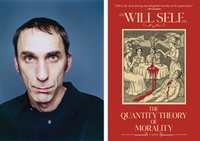
The Quantity Theory of Morality
Will Self. Grove, $27 (368p) ISBN 978-0-8021-6629-6
The vitriol is strong in Self’s devilish latest (after Elaine), which takes place in his familiar middle-class milieu of boorish bankers, blocked artists, and hack writers. Among the multiple narrators is has-been novelist Will, who says of his interchangeable friends, “Their only salient feature were their dicks.” One of them, Phil Szabo, dies in his flat early in the novel, while hosting a dinner party. The subsequent chapters repeat Szabo’s death and its aftermath, becoming more sordid in each telling, especially when Phil narrates from the afterlife. Then, ex-psychiatrist Dr. Zack Busner, a recurring character in Self’s work, turns up and discloses the experiments he’s been conducting with a secret cabal of mad scientists, who use a semi-sentient organic computer named Margaret to measure people’s “morality quotient,” or “propensity to do things they hold to be either right or wrong.” Self’s caustic style is on full display, particularly with Busner’s entertainingly misanthropic philosophizing, as when he claims that psychotherapy makes self-obsessed people think they’re “good,” even as “their actions would be judged as entirely useless, selfish and harmful to one and all.” The novel retreads much of Self’s catalog but that’s hardly a bad thing when exhaustion and regurgitation are the point. (Mar.)
Details
Reviewed on: 12/22/2025
Genre: Fiction
Hardcover - 978-1-80471-122-4
Open Ebook - 978-0-8021-6630-2