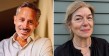
Scottish novelist Ali Smith believes that fiction can offer readers direction—and maybe some needed clarity—in a fractured and polarized world. “Reading a book, we get to be more than ourselves, bigger than ourselves,” Smith says. “We get to be communal and yet stay individual. Books are where imagination and reality meet.”
The intersection of life and art has preoccupied Smith throughout her career. A genre-bending author, she writes about time, chance, and death, and how people use language, creativity, and storytelling to survive and thrive in difficult times. She’s the author of numerous works of fiction, including her 1995 debut, Free Love and Other Stories, and the novels Hotel World, How to Be Both, and her ambitious Seasonal Quartet. She’s received the Goldsmiths Prize and the Orwell Prize for Political Fiction, and has been shortlisted four times for the Booker Prize. In 2015, she was appointed commander of the Order of the British Empire, and her books have been translated into 40 languages, according to her publisher, Pantheon.
Smith’s new novel, Glyph, out in May, is a companion work to her 2024 dystopian novel Gliff, and follows two sisters, Petra and Patricia, who live in a stark near-future Britain, a police state where misinformation and violence run rampant, journalists have been silenced, and AI has eroded literary culture and learning. The book, which has a loose plot structure and combines speculative and fantastical elements, was partly inspired by a haunting story that Smith heard in her youth about someone who, during WWII in France, encountered a strange shape in the road, only to discover it was a person, completely flattened. What does it mean to grind a living person into the ground? Smith asked herself. “That started me wondering not just about dimensionality, human and aesthetic, but also about why it is that humans want to make a mark,” she says. “Why we ever write anything or create any art.”
Glyph opens in the 1990s, when young Petra and Patricia hear old war stories from family members and other adults, including the story of a soldier who tried to save a blind horse during WWI, and a civilian who was crushed by a military convoy during WWII. Patricia is upset by the story of the “flattened person,” and Petra pretends to speak to the person’s ghost to comfort her. Soon, Patricia begins to see a spirit entity, whom the sisters name Glyph, and who may be a manifestation of the dead person, in their house.
As the sisters enter adulthood in a troubled near future not entirely unlike the present, life turns more difficult: people aren’t reading books, handwriting is a lost art form, and language has been weaponized by those in power. Things come to a head when Petra phones Patricia to say she thinks there’s a blind horse in her bedroom, and Patricia rushes to Petra’s side to help her deal with the situation. Their meeting becomes an opportunity for the sisters to reaffirm their bond and love of storytelling, in a magical and ultimately hopeful tale about history, family lore, ghosts, and the power of imagination as a source of salvation during dark periods.
Smith says she sees books and stories as porous and organic things, living among us in the world. The world can feel exhausting, full of discord, and dominated by technology, but it’s also the place where human ingenuity shines. “The skills that the arts gift us all—skills of analysis, of having enough objectivity to see what any dominant narrative is doing, and of cultivating warmth, lightness, and merriment against the dark—are powerful tools,” she explains.
Simon Prosser, publishing director of Hamish Hamilton in the U.K., has been Smith’s editor for the past 25 years, and describes her as a force for good. “Ali’s one of those rare people, both in person and on the page, where time spent with her can help you to see and feel in new ways,” Prosser says. He adds that the author, who doesn’t plot out her books in advance, never shows him her works in progress. “I don’t know much until the moment I read the manuscript. There’s always a surprise, and it’s always a wonderful thing.”
Smith was born in 1962 in Inverness, amid the beauty of the Scottish Highlands, and was the youngest of five kids, whose closest brother was six years her senior. “I inherited a strong family structure and simultaneously some of the benefits of only-child individuality,” she says. Smith studied English language and literature at the University of Aberdeen from 1980 to 1985, then attended Newnham College, Cambridge, where she worked for five years toward a PhD in American and Irish modernism. She never finished her degree, and chose instead to focus on writing. “I was a pretty crap academic,” she recalls.
In the late ’80s and early ’90s, Smith struggled with chronic fatigue syndrome, including while writing Free Love. “It physically knocked me out for two or three years,” she says. “And though that was pretty tough I know so many people have had it a level way above mine and had to, have to, cope with it a lot more roughly than I did.”
Smith, who lives with her partner, Sarah Wood, a filmmaker and artist, occasionally still experiences CFS symptoms, but it doesn’t slow her down in the same way anymore. “It comes and goes, but faintly, far away, like a cousin twice removed seen through a mist,” she says. “I’m attentive to it. I pull up a chair for it. Sit down. How’ve you been? Can I get you a cup of tea?”
Tracy Bohan, Smith’s U.K. agent, describes the author as a joyful person who’s utterly serious about her work, which is both politically intelligent and emotionally true. “I think of Ali as a great European novelist,” Bohan says. “She’s kind of borderless. Story is at the heart of everything she does.”
In her life and work, Smith displays a reverence for language, and delights in the human ability to use creativity to inspire connection and effect change. “I think everything we read, and have ever read, influences us, from the words on the side of a pencil onwards,” she says. “That’s how powerful even the slightest of words is.”
Elaine Szewczyk’s writing has appeared in McSweeney’s and other publications. She’s the author of the novel I’m with Stupid.