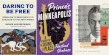
For Black History Month, we're highlighting noteworthy titles that have hit shelves since the end of last year. Among our picks are two novels about the legacy of Black American soldiers in WWII, works of history that trace fights for freedom and justice, and biographies of groundbreaking artists and scholars.
Inharmonious
Tammye Huf. Blackstone, $29.99 (360p) ISBN 979-8-8748-6837-6
Huf (A More Perfect Union) delivers a powerful story of two Black friends who enlist in the Army after Pearl Harbor and wind up with very different lives as veterans. In the wake of the Japanese attack, Florida resident Benny North, who is light-skinned, enlists and passes as white, while his friend Roscoe Crane, who is darker-skinned, is assigned to a unit for Black soldiers. Before deploying to Europe, Benny asks Roscoe to marry his sister, Cora, hoping that at least one of them will survive the war and return home to support her. Roscoe agrees, but their union is loveless, partly because Cora still loves her old beau, Lee, who has also enlisted. In Wales, Roscoe falls in love with a white woman and finds the type of acceptance he never had as a Black man in the U.S. But when he returns to Florida to fulfill his promise to Benny, he finds few prospects, and gets stuck in a demeaning job. Meanwhile, Benny is able to secure a mortgage through the GI Bill, but Roscoe is denied due to redlining. When Lee returns home, he and Cora advocate for Black veterans denied GI benefits, leading to intimidation from a racist mob that wields crowbars and tire irons outside Lee’s house. Huf enhances the drama with engrossing romance subplots, but the heart of the novel lies in its depiction of inequality among WWII veterans and the danger in fighting it. This will move readers. Agent: Tanera Simons, Greenstone Literary. (Feb.) Keeper of Lost Children
Sadeqa Johnson. 37 Ink, $30 (464p) ISBN 978-1-66806-991-2
The assured latest from Johnson (The House of Eve) links the stories of three Black Americans in Europe and the U.S. after WWII. It begins in 1965 Maryland, where Black teenager Sophia Clark escapes the drudgery of farm work after receiving a scholarship to an elite boarding school. She bonds with classmate Max, a Black boy who was adopted from a German orphanage, and she wonders why “something stirred inside her” when he speaks in German. Meanwhile, in 1950s Germany, Ethel Gathers, whose husband is serving in the Army, adopts from a local orphanage multiple mixed-race children who were born to American GIs stationed in Germany and works to find homes in the U.S. for the orphanage’s other mixed-race children. The third story line takes place in 1948 Mannheim, Germany, where Ozzie Philips, a soldier from Philadelphia, has an affair with Jelka, a white German woman who becomes pregnant with his child. He and Jelka bond over love for their child until he’s stationed elsewhere following the Army’s desegregation. Johnson expertly weaves the narrative threads together, not only through the characters’ shared experiences with racism but also through their individual connections to the German orphanage. The resulting tale offers an immersive view into an overlooked legacy of WWII. Agent: Cherise Fisher, Wendy Sherman Assoc. (Feb.) Daring to Be Free: Rebellion and Resistance of the Enslaved in the Atlantic World
Sudhir Hazareesingh. Farrar, Straus and Giroux, $32 (432p) ISBN 978-0-374-61107-1
“The enslaved rebelled against their captivity throughout the entire [400-year] period” of the Atlantic slave system, according to this stunning revisionist saga. Historian Hazareesingh (Black Spartacus) chronicles myriad examples of “verbal expressions of dissent,” escapes and slave ship mutinies, “poison and sabotage,” acts of self-harm that denied the enslavers one’s labor, as well as “military rebellion, insurgency, and warfare.” He also argues that “enslaved resistance must be evaluated beyond the single criterion of whether it led to the direct overthrow of the institution of slavery,” pointing out that, for centuries, resistance was a vital practice that fostered “dignity and autonomy” for millions. “Resistance thinking,” he writes, cultivated “networks of community and solidarity” that eventually became “forms of self-governance.” Hazareesingh traces this legacy of resistance directly to Africa, where many communities, targeted by “African imperial armies and slave-raiding parties,” refused to submit; many of these groups not only survived but thrived, and seeded oral traditions among those enslaved that resistance was possible. Hazareesingh likewise tracks the spiritual dimensions of resistance thinking throughout the Atlantic world, showing how oath-taking, sacred rituals, and new religious narratives forged new political identities, with one striking example being Nat Turner, who “shrouded his preparations” for rebellion in the story of “his personal journey towards the Kingdom of Heaven.” Pointedly demonstrating that the enslaved’s efforts contributed more to their freedom than “the campaigns of enlightened white abolitionists,” this is a remarkable reorientation of the history of the modern world. (Dec.) Kings and Pawns: Jackie Robinson and Paul Robeson in America
Howard Bryant. Mariner, $32 (320p) ISBN 978-0-06-330816-9
Sports journalist Bryant (Rickey) charts in this powerful history the intersecting paths of baseball star Jackie Robinson and singer and actor Paul Robeson against the backdrop of U.S. segregation and Cold War politics. In 1943, Robeson was the first Black actor to play Othello in a major U.S. production, and a few years later Robinson broke the color line in Major League Baseball when he debuted with the Brooklyn Dodgers. Though the two never met, they were publicly pitted against each other. In 1947, Robeson, an advocate for civil rights and critic of capitalism, was deemed a “sponsor of communism” by the House Committee on Un-American Activities. Encouraged by Dodgers president Branch Rickey, who wanted an opportunity to separate baseball from any associations with communism, Robinson reluctantly agreed to testify against Robeson. In his testimony, Robinson praised American democracy and denounced Robeson, which led government leaders and the mainstream press to laud him as a national hero. This moment, Bryant astutely demonstrates, personified Black Americans’ internal conflict between patriotism and protest, with “one man appearing in conflicted service to and the other hunted for ferocious critique of a country that would ultimately and decisively wound both.” Deeply researched and expertly crafted, this is an important corrective to the popular understanding of race and politics in mid-century America. (Jan.) I’ll Make Me a World: The 100-Year Journey of Black History Month
Jarvis R. Givens. Harper, $24.99 (256p) ISBN 978-0-06-347882-4
African American studies scholar Givens (American Grammar) offers a moving reflection on a century’s worth of Black History Week and Month celebrations. Weaving in memories of his own education and the Black teachers who shaped him, Givens crafts four essays centered on the early roots of Black History Month, death and memorialization, uncovering truths lost in mainstream history, and the future of Black history education. Throughout, he focuses on honoring the many Black educators, archivists, and activists—beginning with teacher and historian Carter G. Woodson, who is credited with establishing the first Negro History Week in February 1926—who documented Black history, working mostly outside of traditional academic institutions until their work became more widely recognized in the mid-20th century. Framing today’s political efforts to erase Black history from schools and public institutions as part of a longer cycle of civil rights battles, Givens argues that history is always political and shaped by those with the authority to record it. He views Black history as critical because it examines abuses of power against vulnerable populations and has always “been used to achieve justice in the present and future.” Looking forward, Givens sees “an urgent need to demystify the process of historical production” for young people, so they understand its political nature. The result is a powerful meditation on Black history’s role in American life today. (Feb.) Prince’s Minneapolis: A Biography of Sound & Place
Rashad Shabazz. Univ. of North Carolina, $24.95 trade paper (272p) ISBN 978-1-4696-9095-7
In this symphonic exploration of the music of Prince, geographer and sociologist Shabazz (Spacializing Blackness) reveals how the history, ecology, and culture of Minneapolis incubated a unique musical style that shaped pop culture worldwide. Many credit Prince with creating the “Minneapolis Sound,” a fusion of funk, R&B, rock, synth-pop, and new wave. But Shabazz argues that, while Prince was “its high priest and the singular figure who impacted it more than anyone,” the Minneapolis sound predated and evolved beyond him, emerging from a unique combination of factors, including the area’s segregated but racially diverse history (Shabazz investigates Indigenous influences on the sound and spotlights the collision of Black and white pop music that occurred along the borders of segregated neighborhoods). Other determining factors include the city’s many empty, unfinished basements and unused “backrooms” where the Minneapolis sound was born, and its commitment to the arts, particularly the Minnesota public school system’s uniquely strong mid-20th-century investment in music education. After mapping the world into which Prince was born, Shabazz analyzes Prince’s life, career, and discography, showing how it was intrinsically shaped by Minneapolis, and shaped Minneapolis in turn. Shabazz’s innovative music analysis imbued with geography, history, and social science deserves a standing ovation. Music lovers will be captivated by this textured view of a beloved artist. (Feb.) The Remarkable Life of Reed Peggram: The Man Who Stared Down World War II in the Name of Love
Ethelene Whitmire. Viking, $30 (320p) ISBN 978-0-593-65419-4
Studying in Paris as the Nazi invasion looms, fleeing the encroaching German occupation across Europe, and escaping an Italian concentration camp with his Danish lover—these are just some of the exploits of queer African American scholar Reed Peggram, whose extraordinary story comes to life in this dazzling biography from historian Whitmire (Regina Anderson Andrews, Harlem Renaissance Librarian). A “treasure trove” of Peggram’s letters from the 1930s and ’40s, shared with the author after a serendipitous meeting with Peggram’s great-niece, forms the basis of the tale. Whitmire explores Peggram’s humble beginnings in Boston and his studies (facilitated by a client of his grandmother, a janitor) at prestigious institutions including the exclusive Boston Latin School and Harvard. The book’s nerve-wracking pace picks up once Peggram goes to study at the Sorbonne. Traveling in the shadow of the impending Nazi offensive, which he calls “a silly old war” and treats as a mere “wrench” in his plans, Peggram focused instead on studying, socializing, and, most significantly, encountering “the love of his life,” Danish painter Arne Gerdahn Hauptmann. Peggram stubbornly refused to evacuate numerous countries until Hauptmann could secure a U.S. visa to escape alongside him, a choice that led to their imprisonment and astonishing rescue by an all–African American regiment in rural Italy. Peggram’s letters movingly convey his willingness to risk his life for love. It’s a vivid glimpse of queer Black life at an exceptionally tumultuous historical moment. (Feb.) Return of the King: The Rebirth of Muhammad Ali and the Rise of Atlanta
Thomas Aiello. Univ. of Nebraska, $36.95 (344p) ISBN 978-1-4962-4418-5
In this stirring chronicle, Valdosta State University history professor Aiello (White Ice) recounts Muhammad Ali’s return to boxing in 1970 and the rise of Black power in Atlanta. Ali had become a “global celebrity” after winning the heavyweight championship in 1964, Aiello explains, but after becoming an outspoken critic of the Vietnam War and a conscientious objector, he was convicted of draft evasion and stripped of his boxing titles. His stand against the draft angered a large part of his fan base, but it also ignited activism in sports, Aiello writes, “giving a kind of permission to Black athletes who wanted to use their platforms for social justice.” Ali was exiled from boxing for more than three years before Leroy Johnson, Georgia’s first Black state senator since Reconstruction, used his influence to get Ali back in the ring in Atlanta, where he would fight Jerry Quarry, the top heavyweight contender and a critic of Ali’s politics. Ali’s return spurred pushback and death threats, but a large swath of Black celebrities and residents showed up in support, and Ali defeated Quarry after three brutal rounds. “Black Atlanta had resurrected Ali,” Aiello writes. His captivating and deeply researched account seamlessly weaves together the politics of race and sports. This is a knockout. (Dec.) Teddy Riley: Remember the Times
Teddy Riley, with Jake Brown. Simon & Schuster, $29 (256p) ISBN 978-1-6680-5645-5
Grammy-winning producer Riley chronicles his more than 40-year-long music career in this down-to-earth debut. Riley grew up a musically talented kid in a 1970s and ’80s New York City gripped by the crack epidemic, an environment that shaped his music as he took “everything from the hustler lifestyle I was seeing and hearing around me” and poured it “into the sound I was crafting,” a mix of rap beats and R&B melodies and vocals that came to be known as new jack swing. Riley sticks close to his professional relationships throughout, recalling time spent in the studio with R&B group Blackstreet along with stars Kool Moe Dee, Bobby Brown, Snoop Dogg, and Michael Jackson (he describes the pedal-to-the-metal production of 1991’s Dangerous). Plenty of space is also devoted to rehashing his toxic working relationship with former manager Gene Griffin, with whom Riley cut ties in 1990. Riley’s tone is appealingly conversational, and colorful behind-the-scene details are interwoven into a big-picture look at how popular music has evolved, from hip-hop to K-pop, during his time in the industry. The result is a candid, illuminating window into the career of one of rap and R&B’s major players. (Feb.) First Freedom: The Story of Opal Lee and Juneteenth
Angélique Roché et al. Oni, $19.99 trade paper (208p) ISBN 978-1-63715-777-0
Activist Opal Lee, known as the Grandmother of Juneteenth, gets an uplifting graphic biography from journalist Roché, with art by Alvin Epps (I Survived Hurricane Katrina, 2005), Millicent Monroe, and Bex Glendining (On Starlit Shores). The account opens in 2021, when Juneteenth is given federal recognition and Granddear (as Lee insists everyone calls her) prepares for a White House visit with President Biden. Lee reflects back on her upbringing in a segregated Texas, and the ways her family were victimized by the surrounding white community. Woven throughout is a historical account of Juneteenth, from the events of 1865 when enslaved people in Texas belatedly learned slavery had been abolished, documented with ample quotes from contemporaneous sources. Subsequent civil rights milestones covered include Martin Luther King Jr.’s assassination. Lee’s lifelong advocacy culminates in her symbolic 1,400-mile walk from Fort Worth to Washington, D.C., in 2016, taken in two-and-a-half-mile increments twice a day to symbolize the two and a half years Texans were kept enslaved after the Emancipation Proclamation (a Union Army major had to be sent to enforce the law). Capable full-color art follows a straightforward template but adds charm and wonder to the educational tone, and Lee’s passionate, distinctive voice is well represented. This shines an overdue spotlight on a modern-day hero. (Feb.)