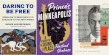
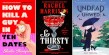
The lexicographer’s True Color uncovers early-20th-century scientist I.H. Godlove’s quest to define colors for Merriam-Webster.
Can you tell us about your research?
I started with a handful of letters that I found in the Merriam-Webster archive when I was working there. And then it blossomed into going to archives of various people and organizations mentioned in that correspondence. Through one of those, I found I.H. Godlove’s grandchildren and just contacted them out of nowhere. They had a family archive that Margaret, his wife, had kept. The book is really about the network of relationships that color science created, and the research was about following that network of relationships.
Did you have any moments of real surprise?
Discovering Margaret had completed Godlove’s work, and then going back through these letters that Godlove had sent to Merriam-Webster and suddenly finding evidence of Margaret in them that I hadn’t seen before. Every time I found a little piece of her somewhere, it was thrilling. I was really familiar with Godlove’s handwriting and Margaret’s handwriting, and one time I was in a library looking at a corporate archive, and basically found all of this evidence in Margaret’s handwriting of her working for this company. And you know how you’re supposed to be quiet in archives—I just made this huge noise. I had to apologize to all the people in the room.
How much has color science changed since the Godloves’ time?
There are things now that the Godloves absolutely never would have dreamed of. Holographic colors, Day-Glo colors. Color-mixing computers—now every corner hardware store has one. But the thing that fascinates me is that we have all these tools at our disposal for color analysis, but we still like and rely on human input about color more than any sort of
scientific tool.
I love the way you affectionately skewer lexicographers. Are you one of them, or are you like the cool lexicographer who has escaped into a different world?
I’m still a lexicographer, for sure. If I’m at a party, God forbid, I am in the corner, I’m very quiet, I’m listening to everyone else’s conversation. And if someone uses some interesting piece of slang, I’m making note of it.
You’re not jumping in to correct, I assume.
Oh God, no. The thing about lexicographers is we are never judging what anyone says. We are just taking note of it with delight.
It can be hard to make jokes directly to the reader. But your jokes were so good.
Obviously, I love doing those little asides—the look to camera. I actually send them to one of my kids, and I’m like, Is this too much? And she’ll let me know: yeah, this is extra.