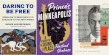
In American Rambler (Knopf, May), Isaac Fitzgerald trades the raw honesty of Dirtbag, Massachusetts (2022) for an epic journey—walking (and sometimes driving) from Leominster, Mass., to Fort Wayne, Ind., following the trail of folk hero Johnny Appleseed (17741845). What begins as a childhood fascination becomes a profound meditation on myth-making, faith, and the stories we tell. Fitzgerald spoke with PW about travel narratives, vulnerability in memoir, and why we can never fully separate legend from truth.
Your debut memoir Dirtbag, Massachusetts was a collection of personal essays about growing up unhoused, family challenges, and misspent youth. How does American Rambler continue that narrative?
After reading Dirtbag, my mother asked me, “What about all the camping and canoe trips? There were good times too. Why didn’t you write about those?” When I started this project, I was genuinely trying to answer her question. But I’m also looking at the stories I’ve been telling myself my whole life, through the lens of John Chapman—Johnny Appleseed’s real name. There’s this Disney version of him, this American legend, and then the real man. I’m trying to separate the story from fact.
What did you discover about Chapman that you didn’t learn in school?
Chapman is depicted as someone wearing rags, with a pot on his head, selflessly planting apple orchards across the frontier. He was actually engaged in a form of land speculation. When he died, he owned 1,200 acres, and the orchards he planted were mostly used for making hard cider and applejack. He was a follower of Emanuel Swedenborg, the Swedish philosopher and scientist, whose faith held that suffering on this earth would be met with heavenly reward, so Chapman chose to live as if he were poor even though he wasn’t.
So there’s truth in the myth, and myth in the truth?
Yes, and it’s the complexity that fascinates me. While there is a truth out there, it’s very rare in our lives that we arrive at something solid, real, and truthful. Chapman lived 200 years ago—in a way he will always be unknowable. You’re never going to be able to take the legend away from the actual person.
I see that in my own life. My father will always be legendary in my mind because he’s my father. But he will also always be unknowable. The same goes for my mother, who suffered serious mental health challenges and killed herself. I will never totally understand what she was going through.
Both of your memoirs are remarkably vulnerable about traumatic experiences. How did you develop the courage to write so openly?
I’m always trying to get better at being braver on the page. And I try to lead by example. If you’re only telling yourself happy stories—which I’ve been guilty of in the past—a deep, dark festering wound is going to be hidden, and it will come out in terrible ways.
What should booksellers know about recommending this book?
I hope they see this as a great travel book and a joyful book about finding love and peacefulness after a life filled with loudness; a book about family and finding things in common with our parents that we don’t realize until we hit middle age; about parts of the country that are easy to overlook; and about not shying away from tough conversations. It’s also a story about self-mythologizing and getting to the truth. That’s what John Chapman represents to me—his Swedenborgianism is wild, the Disney version is cute, and at the end of the day, he is all these different things. He’s complex. So are we.
Isaac Fitzgerald will appear with Aimee Nezhukumatathil at the closing keynote, Feb. 26.