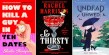
First, it was fairies, courtesy of Sarah J. Maas’s A Court of Thorns and Roses. Then, dragons, thanks to Rebecca Yarros’s Fourth Wing. Now, more than a few fantasy enthusiasts on BookTok have declared 2025 the year of the lady knight. Indeed, at least 10 different chivalric fantasies starring young women in armor have been published in as many months.
While not all lady knight novels have fantastical elements, their connection to the romantasy boom is evident to the editors who talked with PW about the trend. Orbit editor Tiana Coven, who worked on Tashi Suri’s The Isle in the Silver Sea, a sapphic romance about a knight and a witch that was released in October, says the popularity of romantasy has led to “everybody wanting lush, beautiful romantic books—and there’s kind of nothing more romantic than a knight,” which she calls a particularly “sexy archetype.”
Editor Sarah Homer at Storytide, a new imprint for middle grade and teen readers launched by HarperCollins earlier this year, agrees that the lady knight subgenre is a natural offshoot of romantasy.
“To us, this trend feels like it dovetails perfectly with romantasy—the worldbuilding and magic systems at play scratch slightly different itches, but there are enough similarities in the themes present in both genres that there’s a strong overlap in readership,” says Homer, who worked on Amie Kaufman and Meagan Spooner’s YA novel Lady’s Knight, released in June, with Storytide VP and publisher Tara Weikum.
Readers of romantasy are usually interested in seeing strong women in their stories, Homer and Weikum say, noting that in the current political climate, the notion of young women flexing their agency and facing their enemies can be a salve. “Honestly,” Homer jokes, “vanquishing your foes with a fire-breathing dragon sounds like a walk in the park compared to some of the challenges in our modern-day reality.”
“Strong women in charge is unfortunately escapist,” says Tor executive editor Miriam Weinberg, who worked on Alix E. Harrow’s The Everlasting, published in October. But beyond offering an alternate reality to escape into, she explains, these books also “challenge the traditional structures of power when we’re looking at subverting different tropes and looking at the idea that power isn’t all it’s cracked up to be.”
What’s more, the novels play with gender norms at a moment when certain cultural forces are pushing for a return to tradition. “There’s just something interesting and subversive about women taking on that male role,” says Orbit executive editor Brit Hvide, who worked on Rachel Gillig’s Knight and the Moth. The gothic fairy tale has sold more than 187,000 print copies since it came out in May, according to Circana BookScan.
For Weinberg, much of the appeal of the subgenre lies in its flipping of a familiar trope: the valiant knight who rescues the damsel in distress. “That subversion to me is inherently queer,” she says. “I think that lady knights, with whoever they’re falling in love with, is a fun way to subvert either an expectation of performance masculinity, performance femininity, or performance heterosexuality.”
While many lady knight novels center on queer relationships between women, they can feature all kinds of pairings, sapphic and otherwise. The Second Death of Locke by V.L. Bovalino, for instance, which came out in September, features a bisexual lady knight and a pansexual mage who are magically bound together and embark on an epic quest.
This subversion adds a unique angle to the romance plots that largely serve as these books’ narrative engines. Madeleine Colavita, senior editor at Forever who worked on Bovalino’s novel, calls the recent spate of lady knight novels “deeply romantic in a way that is different from other trending romantasies.” Unlike many other romantasy offerings, she says, “these books are speaking to a desire for desire, for unfulfilled yearning that makes your heart ache.”
For Orbit’s Coven, the combination of both the cultural and emotional resonance of these women warriors is the perfect recipe for a lasting trend. “I hope to see lady knights become a thing, because it’s super sexy, super fun, and super engaging,” she says. “And I think especially women really are drawn to these novels, because I feel like it puts power back into their own hands.”