In J.R. Thornton’s sophomore novel, Lucien, a scholarship student falls under the sway of his charming, dangerous roommate and becomes a reluctant accomplice in a scheme to sell fake art.
The university campus is a unique place that exists alongside the rest of society yet remains curiously detached from it—a self-contained world with its own rules and hierarchies. For most students, college is the first time they’ve ever lived away from home. For some, it’s the first time they’re exposed to the freedom, responsibility, and pressure of making consequential decisions about their lives. It’s also a chance to start over, an opportunity for people to leave behind the identities assigned to them in high school and decide who they want to become. It’s a place of intellectual and personal discovery, but also of intense social pressure.
I’ve always been drawn to the campus novel for the canvas it offers to explore class, ambition, and the urge to reinvent oneself. The five novels below are standout examples of the form, each offering a vivid glimpse into academic life and influencing the writing of Lucien in some way.

Pnin
Both wonderfully funny and profoundly sad, Pnin recounts the misadventures of a hapless Russian émigré professor at a provincial (and fictional) New England university. Inspired by Nabokov’s own life and his experiences teaching at Cornell, the novel is in part a satire of academic life and the small-minded pettiness of faculty politics, and in part a poignant look at the loneliness of the immigrant professor. Pnin is a man displaced, a carrier of a culture that has been destroyed, stumbling through life one malapropism at a time, trying to find his footing in a world that sees him as a lovable eccentric at best.
The narrator, a complex, smug, and somewhat cruel Russian-American academic (thought to be an exaggerated version of Nabokov himself), pokes fun at Pnin and mocks him. By the novel’s end, though, the joke seems to turn back on the narrator. Pnin, dismissed as foolish and inept, emerges as the more humane and dignified figure.
Favorite line: “There is an old American saying, ‘He who lives in a glass house should not try to kill two birds with one stone.’”

Brideshead Revisited
While most of Waugh’s novel takes place after its characters graduate from Oxford, that university is the site of the plot’s inciting incident: the meeting of Charles Ryder and the charming-yet-eccentric aristocrat Sebastian Flyte. Sebastian ushers Charles into a world of languid decadence, aesthetic refinement, and careless privilege that feels delightfully removed from his own middle-class upbringing.
Charles is completely captivated by Brideshead, Sebastian’s ancestral home, which represents a dying way of life. Waugh captures the intoxicating nature of being welcomed into a sphere of privilege that feels like a dream—a form of seduction that relies on the sheer, gravitational pull of wealth, history, and glamour. Yet beneath the gilded surface lies a deep unhappiness characterized by emotional repression, spiritual struggle, and denial over the decline of a social order.
Favorite line: “These memories, which are my life—for we possess nothing certainly except the past—were always with me. Like the pigeons of St. Mark’s, they were everywhere, under my feet, singly, in pairs, in little honey-voiced congregations, nodding, strutting, winking, rolling the tender feathers of their necks, perching sometimes, if I stood still, on my shoulder or pecking a broken biscuit from between my lips; until, suddenly, the noon gun boomed and in a moment, with a flutter and sweep of wings, the pavement was bare and the whole sky above dark with a tumult of fowl.”

This Side of Paradise
A somewhat experimental novel stitched together from fragments of narrative, poetry, and stream-of-consciousness, Fitzgerald’s debut is probably the least structured of his four major works. Set partly at Princeton in the years leading up to the First World War, the novel traces the emotional and intellectual development of the egocentric Amory Blaine. What makes This Side of Paradise so essential is its understanding of the university as a stage for self-invention. Amory’s desperate, often clumsy, attempts to try on different personas is a core struggle for any young person. While the plot lacks the controlled tightness of The Great Gatsby, Fitzgerald’s unmistakable energy and talent come through. After originally giving it the questionable title The Romantic Egoist, Fitzgerald fortunately chose a far better option inspired by a line from the Rupert Brooke poem, “Tiare Tahiti.”
Favorite line: “It was always the becoming he dreamed of, never the being.”
The Secret History
When Richard Papen arrives at Hampden College in Vermont, he’s desperate to escape his mundane California background. He finds his ticket in a tiny, exclusive classics program taught by the enigmatic Julian Morrow. What I’ve always found so compelling, and what I returned to while writing Lucien, is the terrifying precision with which Tartt depicts the way an outsider is susceptible to seduction. Richard isn’t just joining a study group; he’s being absorbed into a sealed-off world governed by its own morality. The allure of that belonging is so strong it leads to his complicity in murder. It’s a chilling look at how a desire for a different life can make you lose yourself entirely.
Favorite line: “The snow in the mountains was melting and Bunny had been dead for several weeks before we came to understand the gravity of our situation.”
Lucky Jim
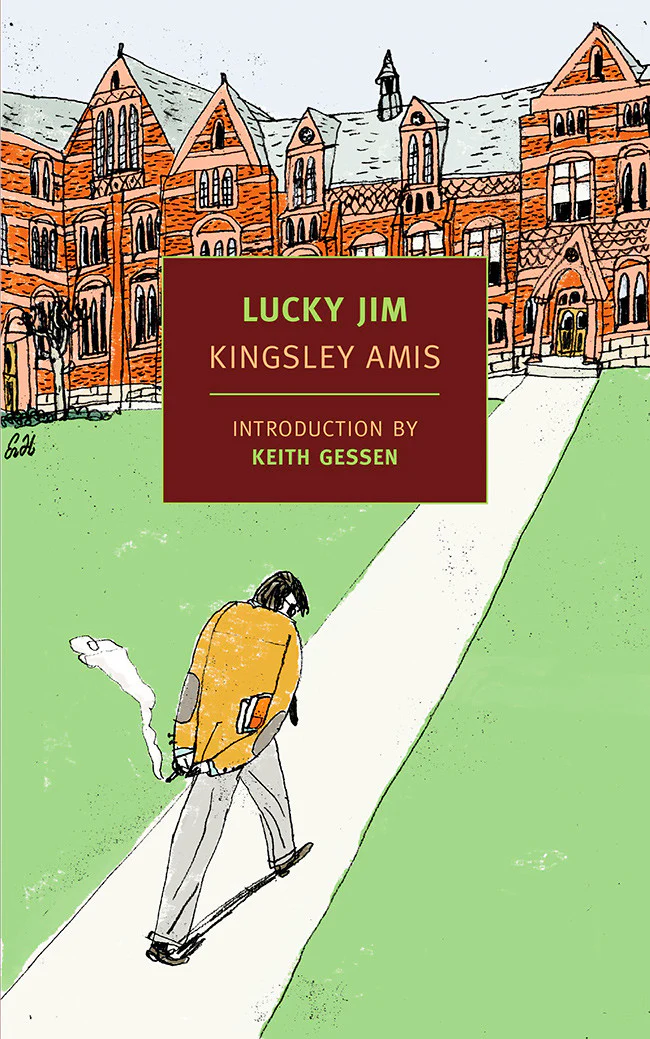
A true classic of the genre, Amis’s merciless satire is a takedown of the pretension, pettiness, and absurdity of academic life. Jim Dixon, a junior history lecturer at a small-town university, wages a private war against the pompous self-importance of his colleagues and their arcane traditions. As professional disaster and romantic confusion close in, his barely contained contempt erupts in scenes of comic brilliance.
Favorite line: “Dixon was alive again. Consciousness was upon him before he could get out of the way…”