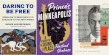
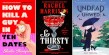
Many of the movies up for Oscar gold this year drew—directly or indirectly—from books. We've collected PW's original takes on several of those titles.
For the much-nominated One Battle After Another, Paul Thomas Anderson pulled loosely from Thomas Pynchon's Vineland; with Hamnet, recent Oscar winner Chloé Zhao transformed Maggie O'Farrell's novel into a moody cinematic tearjerker all its own. Other books on this list have lighter associations: Fiona Sampson's In Search of Mary Shelley gives context to the writing of Frankenstein, which Guillermo del Toro refashioned into a 2026 best picture nominee, and Henri Troyat's Turgenev details the life of the Russian master, whose 1852 short story, "The Singers," was adapted into a contender for best live-action short film.
Editor's Note: The historical reviews and previews mentioned below are presented in the varying editorial styles in which they originally appeared in Publishers Weekly.
 A Ship Without a Sail: The Life of Lorenz Hart
The lyricist who, with composer Richard Rodgers, penned “Blue Moon,” “The Lady Is a Tramp,” and other standards is a figure worthy of his own bittersweet songs in this graceful biography. A squat gay man who lived with his mother and had the kind of “laughable... unphotographable” looks he toasted in “My Funny Valentine,” Hart is a jaunty, cigar-chomping bon vivant with a secretly wounded soul, an extraordinary poetic facility—his greatest verses seem to have been dashed off on half an hour’s deadline—and a ruinous thirst for booze. Journalist Marmorstein (Hollywood Rhapsody) resists the temptation to psychoanalyze and instead explores Hart’s personality mainly through shrewd readings of his lyrics as they veer between “enthralling new romance and a lonely, unforgiving desolation.” He holds to a middle-distance perspective, organizing the narrative around lively accounts of Rodgers and Hart’s Broadway and Hollywood musical projects, with Hart’s self-destructive excesses surfacing in matter-of-fact vignettes amid the showbiz swirl. Along the way, he paints a vivid panorama of pre-WWII musical theater and the efflorescence of Jewish-American tune- and word-smithing that created it. Marmorstein’s take on his subject’s life feels like a Rodgers and Hart show, nicely balanced between exhilarating spectacle and pithy revelations of character. Agent: Dan Conaway, Writers House. (July)
In Search of Mary Shelley
Hamnet
Paradise: One Town’s Struggle to Survive an American Wildfire
Train Dreams
Readers eager for a fat follow-up to Tree of Smoke could be forgiven a modicum of skepticism at this tidy volume—a reissue of a 2003 O. Henry Prize–winning novella that originally appeared in the Paris Review—but it would be a shame to pass up a chance to encounter the synthesis of Johnson's epic sensibilities rendered in miniature in the clipped tone of Jesus' Son. The story is a snapshot of early 20th-century America as railroad laborer Robert Granier toils along the rails that will connect the states and transform his itinerant way of life. Drinking in tent towns and spending summers in the wilds of Idaho, Granier misses the fire back home that leaves no trace of his wife and child. The years bring diminishing opportunities, strange encounters, and stranger dreams, but it's not until after participating in the miracle of flight—and a life-changing encounter with a mythical monster—that Granier realizes what he's been looking for. An ode to the vanished West that captures the splendor of the Rockies as much as the small human mysteries that pass through them, this svelte stand-alone has the virtue of being a gem in itself, and, for the uninitiated, a perfect introduction to Johnson. (Sept.)
Turgenev
Ivan Turgenev was a misfit. Although Russian to the soles of his feet, he was happy only when living abroad. For decades he passionately pursued a stoop-shouldered soprano who responded only with kind words. He drew close to Tsar-hating conspirators, mistrusted revolution and was scorned by conservatives and leftists alike. This engrossing, brisk biography by the French biographer of Tolstoy, Gogol and Chekhov offers no major personal revelations or stunning literary insights. Troyat's achievement in this down-to-earth, concise narrative is to take the measure of a sensitive man torn between literature and love, between Slavophile longings and an attraction to Western liberal ways. There are unforgettable scenes: Turgenev showing Tolstoy how the can-can is danced in Paris; young Ivan, a dandified student in Germany, watched over by a male secretary who is actually his bastard half-brother; Dostoyevsky goading the rootless aristocrat into a towering rage. Troyat seamlessly interweaves Turgenev's letters and journal entries to pin down his enigmatic subject. Photos not seen by PW. (Nov.)
Vineland
Set in Northern California in 1984 and peopled with quirky characters, Pynchon's latest is a series of brilliant set pieces eventually overwhelmed by its own frenzied exuberance. 200,000 first printing. (Feb.)