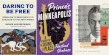
Authors Peter Parnell and Justin Richardson, whose First Amendment claim against the Escambia County School Board (ESCD) in Florida was dismissed in federal court on September 30, filed a notice of appeal to the Eleventh Circuit on October 3. Parnell, Richardson, and an unnamed elementary school student, B.G., sued the board to restore their picture book, And Tango Makes Three, to five Escambia County public school libraries that previously had copies.
Tango, published by Simon & Schuster in 2005, is based on the true story of two male chinstrap penguins at the Central Park Zoo who incubated an egg and raised a chick together. “Tango was the very first penguin in the zoo to have two daddies,” the book explains.
Between 2006–2019, at least six ECSD media specialists independently reviewed the book and found it appropriate for their school collections, the plaintiffs attested. Beginning in 2022, an ECSD employee challenged some 36 school library books including Tango for violating Florida House Bill 1557, also known as the Parental Rights in Education Act or the “don’t say gay” bill. HB 1557 prohibits instruction “on sexual orientation or gender identity” in K–3 curricula.
When ECSD allowed the book removals to stand, attorneys for the plaintiffs argued that Tango was removed “based on unlawful viewpoint discrimination” against Parnell and Richardson’s representation of a “happy, healthy, and loving” same-sex relationship. They also stated that ECSB “interfered with the Author Plaintiffs’ ability to distribute their published materials and ideas to their intended audience.”
Chief Judge Allen C. Winsor, a 2019 Trump appointee to the U.S. District Court for the Northern District of Florida, denied the plaintiffs’ motion for summary judgment last week. The judge said that “the board did not violate the First Amendment when it decided to remove Tango from school libraries.”
“The board’s lead argument is that school library curation does not implicate any students’ or authors’ First Amendment rights at all,” Judge Winsor wrote in his final order. “Thus, the argument continues, even if the board removed a book based on its viewpoint, the removal would not be unlawful. I agree, and that is enough to resolve this case.”
Judge Winsor further found, “The Author Plaintiffs have no First Amendment right to speak through the library, and B.G. has no First Amendment right to receive the Author Plaintiffs’ message through the library.” He went on: “Nor do the Author Plaintiffs have a First Amendment right to demand the library ignore the book’s viewpoint when determining whether to include it in its collection.” He indicated that students could find copies of the book elsewhere.
Lauren Zimmerman, a partner at the litigation firm Selendy Gay and counsel to the plaintiffs, said this decision “means that public school libraries are a First Amendment–free zone and government censorship is completely allowed there, full stop.” She added, “That’s anathema to the First Amendment. Students do not shed their First Amendment rights at the schoolhouse door.”
Zimmerman observed that, throughout his opinion, Judge Winsor referenced the defendants’ claim that school libraries are a form of government speech. Although he declined to pursue that approach, he cites the Fifth Circuit Court of Appeals’ May decision in Little v. Llano County (Tex.), in which a plurality said a library’s collection decisions do constitute government speech. “He reached into another jurisdiction that has no precedential value on the Northern District of Florida, and he relied on that largely for his reasoning,” Zimmerman said. “It’s also a case that’s about a public library, not a public-school library.”
Members of the Escambia County School Board have not yet responded to a request for comment.
John Chrastka, executive director at EveryLibrary, said the ruling is “a through-the-looking-glass moment for the First Amendment. By concluding that students have no right to receive information in public school libraries and that the government decides who speaks through them, the court disregards decades of precedent that recognize school libraries as spaces for exploration and learning.”
Chrastka believes the ruling is “dangerous” and runs counter to legal doctrine. “Because this decision stands in sharp contrast to other courts, we hope and expect the Eleventh Circuit will correct this profound misstep,” he said.
Stephana Ferrell, director of research and insight for the Florida Freedom to Read Project, added, “Judge Winsor’s ruling makes painfully clear what has always been at stake in these attempts to censor our libraries: our First Amendment rights to access and share information.” For Ferrell, “the ruling confirms that these censorship efforts are about ensuring our publicly funded libraries are no longer guided by professional expertise or the interests of the people, but by the whims of politicians.”
A necessary tango with censors
Although Tango has been a frequent target of censors, coauthor Richardson told PW, “this is the very first time we’ve had to sue a school district, and we did so reluctantly. It’s simply too important not to take up this fight on behalf of all the many books that are being removed from collections across the country, and all the many children who need those books.”
Until ECSD took Tango off school shelves, Richardson continued, “the law of the land was the 1982 Steven Pico decision. Each of the challenges we encountered ended the same way, with somebody saying, ‘It's a violation of the First Amendment for your school to take this book out of the collection,’ and the book was put back—each and every time.”
Parnell echoed Richardson’s concerns. “The decision about our book indicates that Pico was a non-decision,” Parnell said. “This was shocking to us, because Pico has stood the test of time in terms of protecting books from being removed on the basis of viewpoint and content.”
Zimmerman, their attorney, said that “long-held beliefs about First Amendment rights in the school context have been thrown out the window.” She noted that Judge Winsor’s remarks about government speech could be viewed as “attempts to apply a new legal doctrine in a completely new way, which is quite difficult,” particularly because courts including the Eighth Circuit have as yet rejected that position.
Meanwhile, Zimmerman added, the District Court for the Middle District of Florida ruled in favor of authors and students in Penguin Random House v. Gibson last August, finding portions of Florida’s House Bill 1069 “unconstitutionally vague” and rejecting claims that school libraries engage in government speech.
“If the government is curating, wouldn’t they choose the same collection for every elementary school library or every high school?” Zimmerman asked. “The truth of the matter is, and the evidence in our case shows, that every school library is different, and the librarians look to the makeup of their community, the student body, the parents.”
Parnell and Richardson have hope for the appeal too. “As much as we’re disappointed by the opinion, we are in no way discouraged,” Richardson said, “and that’s in large part because there is such a groundswell of support for the First Amendment in the U.S., and we see this happening all around us.”